Ir al contenido


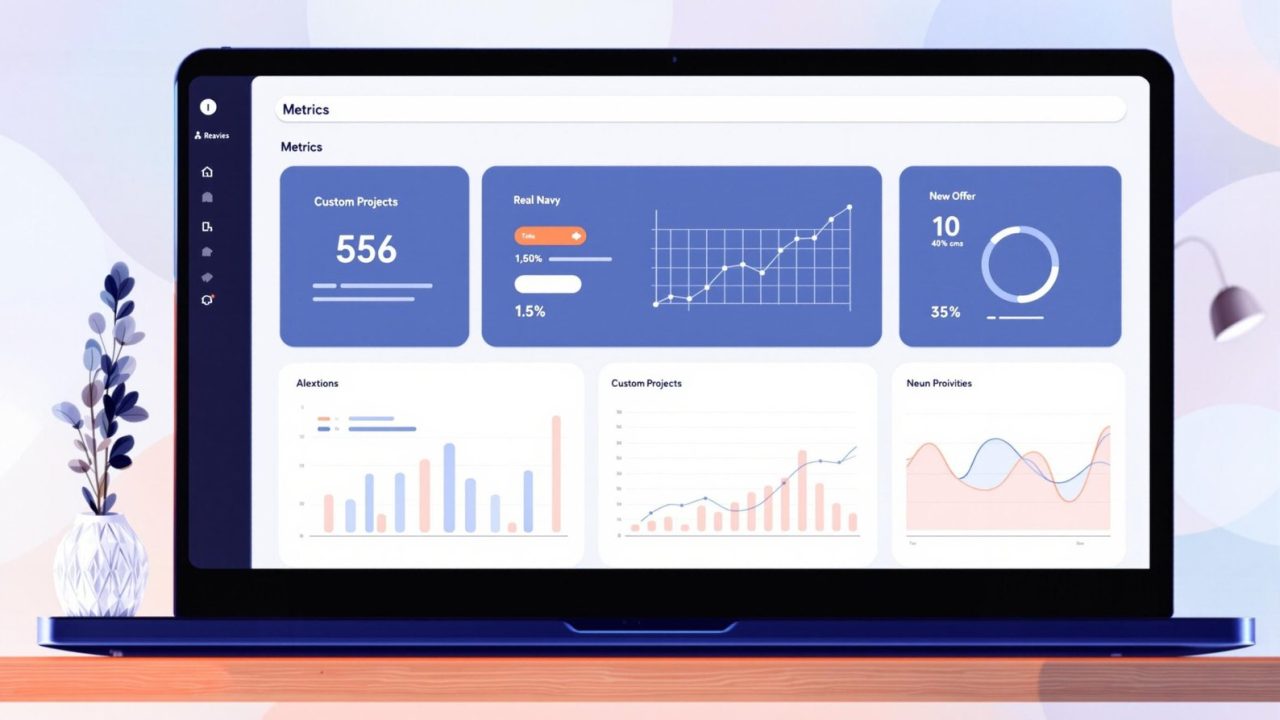
Tracking key metrics is essential for improving product quality, meeting deadlines, and optimizing resources. Here are the six most important metrics for managing software development projects.
- Velocity: Measures team productivity per sprint. It helps teams plan better and deliver consistent results.
- Code Quality: Evaluates maintainability using indicators such as cyclomatic complexity and test coverage.
- Customer Satisfaction: Uses metrics such as NPS and CSAT to measure how well the product meets expectations.
- Lead Time: Analyzes how long it takes from the beginning of development to the delivery of value to the customer.
- Defect Density: Calculates the number of errors per unit of code to ensure reliable software.
- Return on Investment (ROI): Measures the economic impact of the project and its financial viability.
Comparative Table of Metrics
| Metric | Main Focus | Measurement Frequency | Ideal For... |
|---|---|---|---|
| Velocity | Team productivity | Per sprint | Agile projects |
| Code Quality | Maintainability | Continuous | Critical systems |
| Customer Satisfaction | User experience | Quarterly | B2C software |
| Lead Time | Delivery time | Per feature | Urgent releases |
| Defect Density | Product quality | Per release | High availability systems |
| ROI | Business value | Quarterly / Annual | Major investments |
These metrics help identify problems, optimize processes, and ensure better outcomes and higher customer satisfaction.
Essential Metrics in Agile Environments for 2022
Velocity
Velocity is a key metric in custom software development. It represents how much work a team can complete during a specific period, usually measured in story points (Agile methodology) or completed tasks per sprint.
This metric helps teams:
- Estimate work capacity more accurately
- Plan future sprints more effectively
- Improve delivery consistency
According to CA Technologies, teams with consistent velocity are more likely to meet deadlines and satisfy their customers [2]. In LATAM, where resources are often limited, measuring velocity helps maximize delivery without compromising quality.
Factors That Influence Velocity
| Factor | Nivel de impacto |
|---|---|
| Team size | High |
| Task complexity | Medium |
| Team experience | High |
| External factors | Low |
71% of Agile teams already use velocity as a progress metric [1], combining it with other metrics to gain a more complete view of project performance.
Tips to Get the Most Out of This Metric
- Track velocity across multiple sprints to identify patterns.
- Estimate story points accurately to reflect the actual effort required.
- Analyze variations in velocity to implement continuous improvements.
In LATAM, velocity has become an essential tool for custom software development teams. It enables them to maintain a consistent delivery pace while ensuring the quality of the final product.
Velocity has become an essential tool for custom software teams, helping them maintain a steady delivery rhythm while protecting product quality.
2. Code Quality
Delivery speed is important, but it should not come at the expense of code quality. This concept goes beyond simply ensuring that the software works — it must also be easy to maintain, adapt, and scale over time.
Key Metrics for Evaluating Quality
| Indicator | Description |
|---|---|
| Cyclomatic Complexity | Analyzes the structure of the code and how it affects maintainability. |
| Test Coverage | Indicates the percentage of code backed by tests, ensuring greater reliability. |
| Maintainability Index | Measures how easy the code is to maintain and how this may influence costs. |
Economic Savings
According to IBM, fixing errors detected during development can be up to 100 times cheaper than resolving them during the maintenance stage [3]. This reinforces the importance of implementing quality controls from the beginning.
Practical Strategies
To ensure high-quality code, it is important to:
- Use automated analysis tools in continuous integration and delivery processes. A good starting point is setting a minimum 80% test coverage.
- Implement code reviews among team members to encourage continuous improvement.
“Code quality is not just about writing clean code; it is about writing code that is easy to understand, maintain, and extend.” – Colin Hammond, Project Assurance Consultant. [3].
Impact on Productivity
Well-written code reduces the time required to debug errors, allows new features to be developed faster, and lowers the likelihood of production failures.
In regions such as LATAM, where resources are often limited, prioritizing code quality not only optimizes costs but also improves competitiveness. In addition, establishing high quality standards makes it easier to achieve other important metrics, such as lead time, which is essential for agile and efficient development.
Customer Satisfaction
Customer satisfaction reflects how well the final product meets user expectations and needs, making it a key factor in the success of custom software projects.
Key Measurement Indicators
| Metric | Description |
|---|---|
| Net Promoter Score (NPS) | Measures the likelihood that the user will recommend the software. |
| Customer Satisfaction (CSAT) | Measures the level of satisfaction after specific interactions. |
| Customer Effort Score (CES) (CES) | Analyzes how easy it is for the user to use the software. |
Impact on Development
Measuring customer satisfaction helps identify usability issues, prioritize improvements, and allocate development resources more effectively. This ensures that the product better aligns with user expectations.
Measurement Strategies and Tools
To collect useful insights, it is important to:
- Open multiple channels to receive feedback.
- Use surveys integrated directly into the software.
- Analyze how users interact with the platform.
- Continuously monitor changes in satisfaction levels.
Economic Benefits
A satisfied customer not only stays longer but also reduces operational costs and increases adoption of new features. Some of the clearest benefits include:
- Lower user churn: Happy customers are more loyal and less likely to abandon the product.
- Reduced support costs: Fewer issues mean fewer resources spent resolving incidents.
- Higher adoption of new features: Satisfied users trust the product more and are more willing to try improvements.
Integration with Agile Methodologies
In agile development, customer satisfaction acts as a guiding metric in every iteration. Setting clear satisfaction goals and reviewing them in each sprint ensures that the product remains aligned with user needs.
In markets such as LATAM, where competition is intense and resources may be limited, focusing on customer satisfaction can be a decisive factor for product retention and success.
In addition to evaluating customer satisfaction, it is also essential to measure the time required to deliver value, which leads us to the next key metric: lead time.
4. Lead Time
Lead time refers to the period that passes from when a project begins until it is delivered. In LATAM, where teams often deal with limited resources and high demand, optimizing this metric can make a significant difference in competitiveness.
Lead Time Components
| Phase | Description | Impact |
|---|---|---|
| Planning | Analysis and design | Defines the timeline |
| Development | Active coding | Influences delivery speed |
| Testing | Quality control | Ensures reliability |
| Deployment | Final implementation | Delivers value to the customer |
Strategies to Improve Lead Time
To reduce lead time, consider the following strategies:
- Automation: Use tools such as CI/CD to eliminate delays between stages. Automate testing and deployments to accelerate processes.
- Work-in-progress management: Limit the number of tasks in progress to maintain focus and resolve blockers quickly.
- Clear communication: Ensure teams are well coordinated, especially in remote environments, and avoid delays caused by lack of information.
Benefits of Optimizing Lead Time
A more efficient lead time brings several key advantages:
- Faster response to market changes.
- Quicker feedback cycles.
- Reduced operational costs.
- Improved customer experience.
Monitoring and Tracking
Continuously tracking critical points helps identify areas for improvement. This monitoring not only keeps processes agile but also allows teams to detect technical issues quickly.Additionally, while optimizing delivery time is important, the quality of the final product must not be neglected. This connects directly to the evaluation of defect density, the next key metric.
sbb-itb-2170534
5. Defect Density
Defect density measures how many errors exist per unit of code, providing a direct perspective on the quality of the software created. Unlike lead time, which evaluates the speed of the process, this metric focuses exclusively on product quality.
Calculation and Measurement
To calculate defect density, divide the total number of errors by the thousands of lines of code (KLOC). For example, if there are 20 errors in 1,000 lines of code, the defect density would be 0.02 defects per KLOC. It can also be calculated using function points or module size, depending on the needs of the project.
Factors and Strategies
Defect density is influenced by factors such as code complexity, team experience, and development practices. To minimize errors, the following strategies can be applied:
- Conduct systematic code reviews using tools such as SonarQube.
- Implement automated testing, including both unit and integration tests.
- Continuously monitor to identify trends and problematic areas.
Impact on the Project
While code quality reflects how easy the software will be to maintain, defect density shows how frequently errors occur and their impact on the final product.
- Lower maintenance costs
- Higher customer satisfaction
- Less time spent fixing issues
In Latin America, where resources are often more limited, maintaining low defect density is essential for optimizing costs and remaining competitive.Controlling this metric not only improves quality standards but also helps maximize return on investment, a topic we will explore in the next section.
6. Return on Investment (ROI)
Return on Investment (ROI) is a key financial metric used to measure the economic success of a custom software project. While indicators such as defect density evaluate technical quality, ROI focuses on the commercial value generated.
Calculation and Use
ROI is calculated by dividing the project’s net profit by its total cost, and then multiplying the result by 100 to obtain a percentage.For example, if a project costs $500,000 and generates $750,000 in benefits, the ROI would be 50%.
Factors That Influence ROI
| Project Phase | Key Actions |
|---|---|
| Initial Planning | Define KPIs and evaluate financial feasibility |
| During Development | Monitor costs and optimize resources |
| Post-Implementation | Analyze results and adjust strategies |
In Latin America, where budgets are often limited, ROI helps prioritize investments that generate the greatest economic value.
- Development efficiency: Optimal use of resources and time.
- Customer retention: Creating value through long-term relationships.
- Ease of maintenance: Well-designed software reduces long-term costs.
How to Measure and Improve ROI
In the Latin American context, an ROI above 10% is considered positive for software projects. Measuring this metric continuously allows teams to:
- Adjust strategies during development.
- Identify areas where costs can be reduced or revenue increased.
- Support decisions about future investments.
ROI is an essential tool for demonstrating the economic impact of a project, especially in markets such as LATAM. When combined with other indicators, it ensures a balance between quality, delivery timelines, and business results.
Comparative Table
Let’s analyze the key characteristics of these metrics and how they influence custom software projects.
General Comparison of Metrics
| Metric | Main Focus | Impact on the Project | Measurement Frequency | Ideal Application |
|---|---|---|---|---|
| Velocity | Team productivity | Planning | Per sprint | Agile projects |
| Code Quality | Maintainability and reliability | System stability | Continuous | Critical systems |
| Customer Satisfaction | User experience | Retention | Quarterly | B2C software |
| Lead Time | Delivery time | Efficiency | Per feature | Urgent releases |
| Defect Density | Product quality | Reliability | Per release | High availability systems |
| ROI | Business value | Financial viability | Quarterly / Annual | Major investments |
Interrelationship Between Metrics
These metrics do not operate in isolation; they are interconnected and complement each other:
- Improving code quality reduces defects, enhances the customer experience, and in turn boosts ROI.
- A more efficient lead time can accelerate deliveries and increase return on investment.
- Reducing defect density directly contributes to customer satisfaction.
Prioritization by Project Type
| Project Type | Key Metrics | Factors to Consider |
|---|---|---|
| Startups | Velocity, Lead Time, ROI | Need for fast deliveries to remain competitive |
| Critical Systems | Code Quality, Defect Density | Focus on stability and security |
| Enterprise Applications | ROI, Satisfaction, Quality | Efficient use of resources and commercial value |
| Consumer Products | Satisfaction, Velocity | Focus on user experience |
In LATAM, where resources are often limited, focusing on metrics such as ROI and Defect Density can be key to improving competitiveness. A strategic combination of these metrics helps optimize software projects in the region, providing a clearer and more effective perspective.
Conclusion
Using metrics effectively in custom software projects is key to achieving strong results and increasing business value. Companies that apply metrics correctly obtain better outcomes and establish solid foundations for continuously improving their processes.
In the Latin American context, to make the most of these metrics, it is important to:
- Balance productivity and quality: Combining metrics from both aspects helps identify areas for improvement and manage resources more efficiently.
- Adapt to the local environment: In LATAM, metrics such as ROI and customer satisfaction are crucial for demonstrating concrete results and justifying investments.
- Promote a mindset of continuous improvement: It is necessary to review and adjust metrics periodically according to the needs of each project.
Promote a mindset of continuous improvement: It is necessary to review and adjust metrics periodically according to the needs of each project.
- Use resources efficiently and improve product quality.
- Increase customer satisfaction.
- Maximize return on investment.
The key is selecting the most appropriate metrics for each project and applying them consistently to promote continuous improvement in development.
These metrics not only help optimize projects but also answer important questions about their implementation, as explored in the next section.
FAQs
What metrics are important for Agile teams?
Some key metrics in Agile teams include cycle time, team velocity, flow efficiency, and work in progress (WIP). These help measure performance and should be selected according to the specific objectives of the project.
For example, velocity is useful for estimating the team’s capacity, while flow efficiency measures how smoothly the development process runs. WIP, in turn, helps prevent overload by limiting the number of active tasks at the same time.
In LATAM, where teams often operate with limited resources, metrics such as velocity and return on investment (ROI) are especially useful for achieving optimal results with smaller teams.
What are KPIs in software development?
KPIs (Key Performance Indicators) are used to connect software development with business objectives, optimize resources, and support data-driven decision-making. The best KPIs are clear, useful, and understandable for everyone involved.
To implement them effectively, it is important to establish a defined process for collecting data and reviewing it regularly. In addition, KPIs must be measurable and aligned with the objectives of the project.
When applied correctly, these metrics not only improve technical performance but also ensure strong business outcomes, which is especially relevant in regions such as LATAM.